LMS with MLM Integration: How Course Sales and Commissions Work
Selling an online course involves more than accepting a payment. Customers need access to their lessons, administrators need accurate order records, and referral partners need to understand which sales qualify for commissions.
When these tasks happen in separate systems, staff may have to match customer accounts, assign course access, and calculate commissions manually.
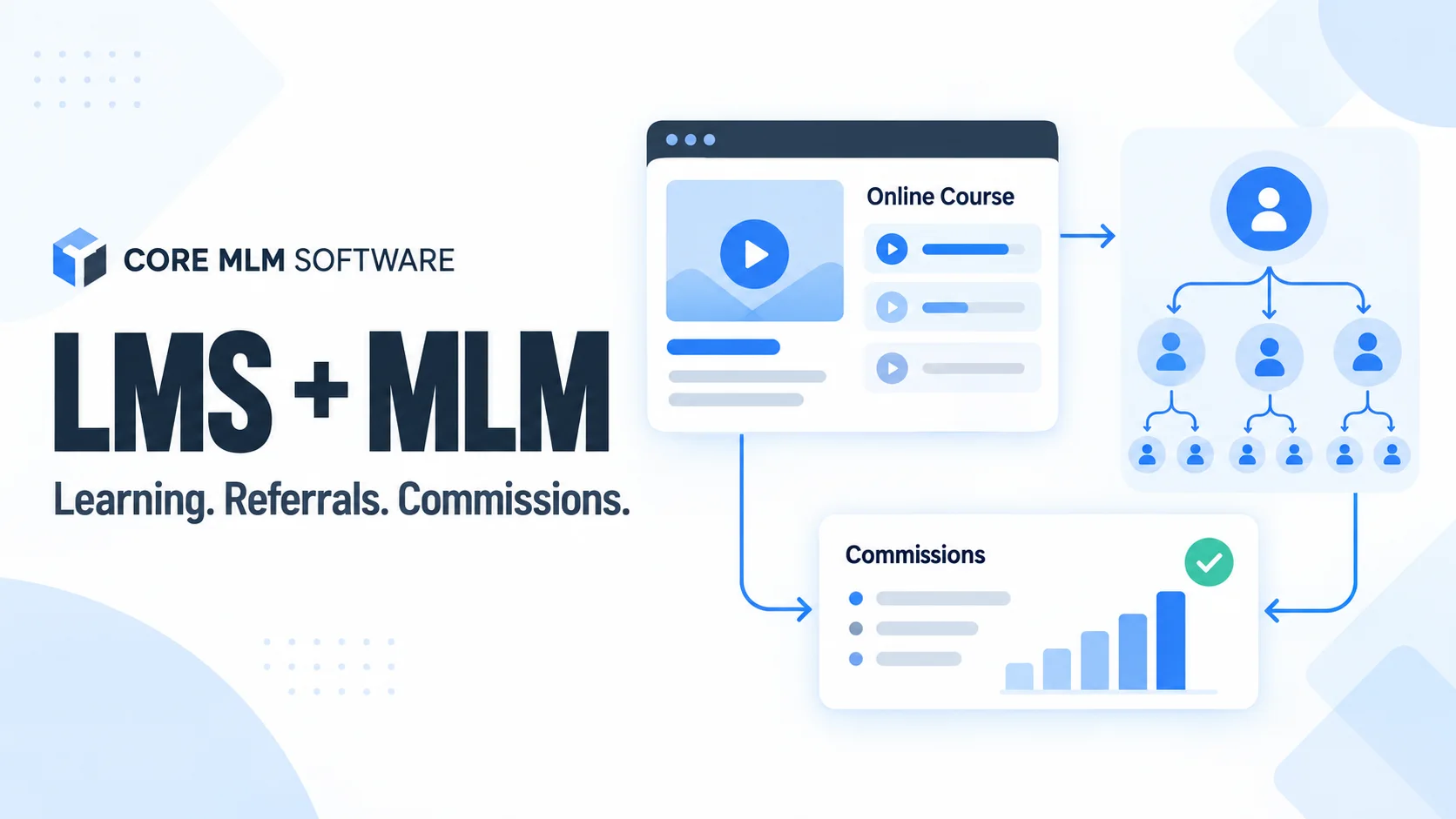
LMS with MLM integration connects the learning platform with the referral and commission system. A well-defined integration helps manage the journey from a referred purchase to course enrolment and commission reporting.
What Is LMS with MLM Integration?
A learning management system (LMS) delivers and manages online learning. Depending on its features, it may handle lessons, assessments, learner progress, and course completion.
MLM software manages distributor relationships, network structures, and compensation rules.
Connecting the two allows relevant purchase and membership information to move between them. The LMS manages the learning experience, while the MLM platform applies the agreed referral and commission rules.
For example, a training business might sell a course through a partner’s referral link. Once payment is confirmed, the customer receives course access and the qualifying sale becomes available for commission calculation.
Not every learner needs to become a distributor. Customer registration and partner enrolment should remain separate unless your business deliberately connects them.
How LMS and MLM Integration Works
The exact process depends on your business rules, but a typical course purchase follows six steps.
1. A Partner Shares a Referral Link
The link identifies the referring partner. Your requirements should explain how attribution works if the buyer changes devices, returns later, or follows another partner’s link.
2. The Customer Purchases a Course
The checkout records the course, customer, order value, payment status, and eligible referral information.
The commission basis also needs to be defined. It might exclude taxes, discounts, or other amounts that do not qualify under your compensation plan.
3. Payment Confirmation Triggers Enrolment
Once the payment reaches the required status, the integration creates or updates the learner’s account and grants the appropriate course access.
A failed or pending payment should follow a different workflow from a successful transaction.
4. The Commission Engine Evaluates the Sale
The MLM system checks:
- The qualifying sale amount.
- The referral relationship.
- The partner’s eligibility.
- The applicable commission rules.
The integration should also prevent the same order from generating duplicate commissions if a payment notification arrives more than once.
5. Partners Review Their Earnings
A commission record should make each calculation understandable. It should identify the qualifying order, commission basis, applicable rate, and whether the amount is pending, approved, or reversed.
Your system may record approved earnings in an internal wallet ledger. Read our guide to [MLM e-wallets and transaction tracking](https://www.coremlmsoftware.com/blog/mlm-ewallet-explained/) to understand how these records support member visibility.
6. Refunds and Cancellations Update Both Systems
A refund may affect course access and previously calculated commissions.
These changes need to follow documented rules so the learning platform and commission records remain consistent.
Course Sales Commission Example
Consider a course with a qualifying sale value of $100.
Under an illustrative two-level referral arrangement:
- Direct referral commission: 10% × $100 = $10.
- Eligible second-level commission: 5% × $100 = $5.
- Total commission: $10 + $5 = $15.
This is a calculation example, not an earnings promise. Actual commissions depend on the compensation rules agreed for your business.
If the purchase is fully refunded before commissions are released, the system could reverse both pending entries. If the commissions have already been paid, you need an agreed adjustment process.
Working through these examples before development helps reveal requirements that a simple feature list may miss.
Key Features to Consider for LMS with MLM Software
Course and Learner Management
Define how courses are created, sold, assigned, and accessed. Discuss:
- Individual courses and course bundles.
- Access periods and expiry dates.
- Repeat purchases and existing learner accounts.
- Assessments and course completion requirements.
- Administrator and learner permissions.
If completion tracking matters, specify what “complete” means. For example, [Moodle’s progress-tracking documentation](https://docs.moodle.org/en/Tracking_progress) describes ways learning platforms can track activity and course completion. Use these as examples when preparing your requirements; capabilities vary between platforms.
Referral and Network Tracking
The system needs clear rules for identifying the referring partner and maintaining network relationships.
Referral sponsorship and placement can be different relationships. Confirm which relationship determines each commission and how changes are handled.
Commission Reporting
Partners should be able to understand their commission records, while administrators need reports that support reconciliation and correction.
Specify which information each role can see. Access to learner records does not automatically mean access to the full distributor network.
Subscription and Renewal Management
If courses are sold through recurring memberships, decide whether each successful renewal qualifies for commissions.
Also define what happens after:
- A failed subscription payment.
- A membership cancellation.
- A plan upgrade or downgrade.
- A subscription expiry.
- A full or partial refund.
Course access and commission eligibility may change at different points.
Integration Monitoring
Ask how administrators will identify failed updates.
If a payment succeeds but enrolment fails, staff need a way to resolve the issue without creating a duplicate order or commission.
A useful integration makes exceptions visible so your team can address them before they turn into repeated customer complaints.
Connecting LMS, CRM, Ecommerce, and MLM Software
Each system has a different role:
- LMS: Manages lessons, learner access, and learning progress.
- CRM: Organises enquiries, customer conversations, and follow-ups.
- Ecommerce: Handles product selection, checkout, and orders.
- MLM software: Manages network relationships and compensation rules.
Your business may need some or all of these capabilities.
For example, a prospective learner could first appear as a CRM enquiry, purchase a course through an ecommerce checkout, receive access through the LMS, and generate a qualifying referral commission in the MLM system.
The important decision is which system owns each record and how updates move between systems. A connected workflow should reduce repeated data entry while keeping responsibilities clear.
What to Test Before Launching Your LMS and MLM Platform
Ask your provider to demonstrate complete scenarios rather than individual screens.
Your testing checklist should include:
1. A new customer purchases through a valid referral link.
2. An existing learner purchases another course.
3. A payment fails and the customer retries.
4. A subscription renews successfully.
5. A customer receives a full or partial refund.
6. A partner does not meet commission eligibility requirements.
7. An integration notification arrives twice.
8. An administrator corrects a failed course enrolment.
Agree on the expected result for each scenario. This creates a practical acceptance checklist for your project.
Frequently Asked Questions About LMS with MLM Integration
Can I Connect an Existing LMS to MLM Software?
Potentially, yes. Feasibility depends on the LMS’s integration options, the available data, and the workflows you need.
Existing systems should be reviewed before a fixed scope or price is confirmed.
Can Customers Buy Courses Without Becoming Distributors?
Yes, that can be part of the design. Learner accounts and distributor accounts can have different roles, permissions, and registration processes.
A course purchase does not have to create a distributor account.
Can Recurring Course Subscriptions Generate Commissions?
They can, if the integration captures qualifying renewal transactions and the compensation plan includes them.
Failed payments, cancellations, and refunds also need explicit rules.
Does Course Completion Automatically Trigger a Commission?
Only if that is a defined requirement.
Payment confirmation, course completion, and commission approval are separate events. Your project scope should specify which event makes a transaction eligible.
What Affects the Cost of LMS and MLM Integration?
Cost depends on the existing platforms, compensation rules, course-access requirements, subscriptions, data migration, reporting, and custom integrations.
A detailed workflow makes quotations easier to compare and helps identify what is included in the initial project.
Discuss Your LMS and MLM Software Requirements
Core MLM Software offers MLM, LMS, CRM, and ecommerce solutions. Share your course model, referral structure, commission examples, and existing platforms so we can define the right approach for your project.
[Contact Core MLM Software](https://www.coremlmsoftware.com/) to request a demonstration and discuss a quotation based on your requirements.